Building Maintainable Content APIs
Version management, backwards compatibility, and adapter patterns for evolving editorial platforms gracefully.

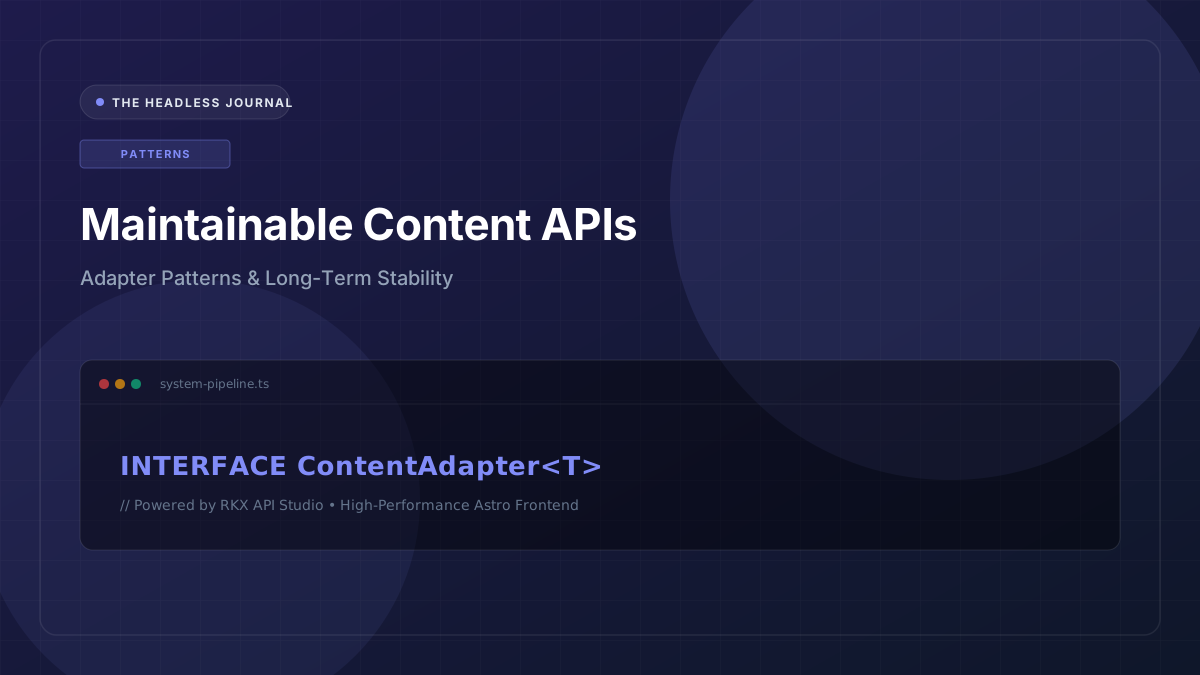
Software systems inevitably change. Content schemas expand, frontend frameworks evolve, and editorial workflows refine. A resilient content architecture anticipates this evolution by establishing clear boundary contracts.
The Adapter Pattern
The single most valuable architectural decision in a headless frontend is the Adapter Pattern. Instead of importing CMS SDKs directly inside Astro page components, the application queries a unified content provider interface:
// lib/content.ts - Clean abstraction boundary
export async function getArticleBySlug(slug: string): Promise<Article | null> {
  return currentAdapter.getArticleBySlug(slug);
}
Why This Matters
- Zero Component Coupling: Page templates (
[slug].astro,index.astro) know nothing about WordPress REST query schemas or mock JSON files. - Seamless Mode Switching: Switching from Demo Mode to Free or Pro API Studio modes involves flipping a configuration adapter, without touching a single UI line.
- Testability: Mock adapters allow CI/CD pipelines to run full build checks and visual regression tests without spinning up a live database.
Conclusion
Invest in clean boundaries early. Your future engineering team—and your editorial staff—will thank you.
Written by Marcus Vance
Principal Frontend Architect
Marcus leads frontend architecture initiatives with a focus on Astro, edge computing, and performant content delivery.
Related Articles
Static Site Generation vs Server-Side Rendering
A comprehensive comparison between SSG, SSR, and hybrid rendering strategies in the modern headless publishing landscape.
 David Chen
Building Modern Headless WordPress Websites
A deep architectural look at why top engineering teams decouple WordPress into a headless content engine paired with modern static site generators.
Marcus Vance
Improving API Performance with Caching
Eliminate database bottlenecks and accelerate SSG builds by implementing intelligent multi-tier caching across your content APIs.
 Elena Rostova